
Ausschnitt aus: MAY 3, 2006 BY SCOTT SCHRANTZ Fixing Up The Old Houses;
And Becky pulled a double-header this weekend, writing two articles for Sunday’s paper. The first one is a feature on another in a long line of renovations going on in Virginia City, the house at 58 North B St. I went up to Virginia City to shoot some photos a couple of years ago, and this house attracted my lens not just because it was run down and falling apart, but also because it was for sale. “Who would buy this house?” I asked myself (secretly wishing that I could, and that I had the money to fix it up). Well, Becky went out and did the research, and found out just who bought it, and how the renovations are coming along.
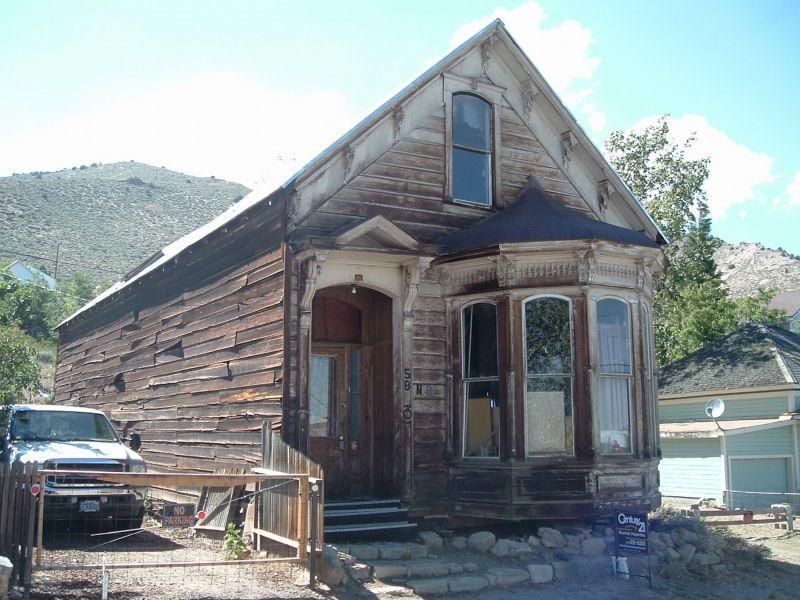
The house at 58 North B in June 2004, when it was still for sale. Click through to see what it looks like today.
The house was built on the rubble of one that had burned in the Great Fire of 1875, and its first resident seems to have been Henry Piper, the brother of John Piper who owned Piper’s Opera House. The new owners are Chris and Carolyn Eichin, a Bay-Area couple who are not just fixing it up to be a home, but also to be a bed and breakfast. It’s a cool story by itself, and HGTV’s If Walls Could Talk filmed a segment about the house that should be airing soon.
Wiederherstellung der Webseite (http://www.goldcountryfamilies.com/articles/B-Street%20House.html) vom 20.Nov.2008
————–
Falling in love with a Victorian house can be a challenging affair. After almost three years of preservation work, the 1876 Henry Piper house found new life as a three guest-room bed and breakfast in the heart of Virginia City, Nevada. Virginia City, founded in 1859 upon the discovery of the richest silver ore in history, may be well-remembered by lovers of the old TV show Bonanza. Enjoying new life as a tourist destination, the town of almost 1,500 inhabitants showcases dozens of Victorian buildings.
Purchasing the historic home in dismal condition in November of 2004, Chris and Carolyn Eichin were set for an adventure in preservation. Commuting from their home in the California Bay Area on weekends, they lovingly worked on the finer details of the home while employing a local contractor for the major issues. The house was first moved four feet to the north to allow access to the window-less south side, and positioned on a new concrete foundation. Uninhabitable at purchase, all major systems; heating, plumbing, wiring, and even walls had to be replaced. Why do this? “Well, we’re just goofy,” they told a reporter.
Actually, there were more realistic restoration goals. The one-and-one-half story, Gothic-Revival wood-frame house at 58 North B Street provides historic significance as an example of an upper-middle-class home. Built immediately after the “Great Fire”, the property is listed in the National Register of Historic Places as part of the Comstock Historic District. As such, the property was eligible for the National Park Service federal historic rehabilitation tax credits for restoration to a commercial use. Thus, the bed and breakfast idea took shape.
Attention to detail guided the restoration. Vintage-era shiplap siding is not readily available, so specialty milling was needed to replace weathered exterior wood. Chris, a mechanical engineer with a love for woodworking, personally replicated the original windows, wood trim on interior and exterior facades, and repaired original wood floors. Guest rooms with private baths were created upstairs, but only after replacing damaged floor joists, in a space gutted by previous owners.
The “B” Street House is one of the few remaining “row” houses in Virginia City. Sometimes called “shotgun” houses, they sit narrow and long on the lot. A five-window bay facing B Street, adorned by a terne steel half-dome, now sports silver paint to replicate the original color. Similar to homes in San Francisco from this era, the painted lady now wears red, white, black, and terra cotta trim.
Researching the house history proved almost as challenging as the rehabilitation work itself. The HGTV show ”If Walls Could Talk” filmed the progress in April, 2006. Melted glass from under the house spoke of the destruction fraught by the Great Fire of 1875. Knowing nothing about the home’s original owners, an 1876 ticket stub and a medicine bottle in the house walls, provided clues to previous inhabitants.
Henry Piper, the home’s original owner rose to local fame with brother John in their Piper’s Opera House business. He appeared as the primary manager of the Piper Brothers’ saloon at the corner of “B” and Union Streets, in the Opera House complex. The Piper brothers had a long history in Virginia City from their arrival in 1860 to an 1894 departure for Henry and his family. Henry’s two children were born in the house, and his rise to local prominence included a stint as a Nevada State Assemblyman.
After the Henry Piper family left Virginia City, the house changed hands several times. First sold to druggist Albert Lernhart in 1893, it passed to barber Robert Rauhut, a long time Virginia City resident in 1900. A spunky 18-year old Irene Cooper rented the house from Rauhut from 1908 to 1912. She, in turn, rented rooms to miners. Later, a Virginia and Truckee stationmaster owned the house, but rented it out. Most of its twentieth century life was spent as a rental house, and as the mining industry diminished, the house became more and more unloved.
The current bed and breakfast renovation provides three guest bedrooms, all upstairs. One room is named for newspaperman Sam Davis, a guest in the home in 1878. A picturesque 100-mile view from the east-facing window greets visitors to this room. The west room, decorated in pale green, is named for the famed Virginia & Truckee Railroad. The coziest, middle room named Uncle Henry’s Room, honors a joke on the fact that Henry Piper hired his relatives as bartenders in his saloon. Decorated in period antiques and reproductions, the elegance enjoyed by the upper middle class Henry Piper family is apparent as you sit in the parlor or peruse books from the library. The crowning glory of the “B” Street House is a modern reproduction of the original 1876 parlor wallpaper. In beautiful shades of silver and gold it speaks to the knowledge the original owners must have had that their fortunes were tied to the great Comstock Lode beneath their feet.
Yard sales and estate sales provided Eastlake furniture, as Chris and Carolyn shopped for just the right 1876 look in furnishing the B&B. The design and detail of the restored Victorian “B” Street House speaks to the elegance that the town enjoyed at its zenith and the love the couple enjoys the house today.
photo courtsey B-Street House
©